Why Your Evenings Need a Different Kind of Calm
My partner and I used to collapse on the couch after work, scroll phones in silence, then wonder why we felt more drained than rested. We tried the usual date-night lists: candlelit dinners, board games, even a couples massage class. But when you're both running on empty, the last thing you need is another activity that demands planning, energy, or conversation.
This article is for couples who are genuinely exhausted, overstimulated, and craving connection without effort. I've spent years experimenting with calming evening activities for couples, failing often, and finally landing on rituals that shift us from stress to stillness together. You'll find zero-prep ideas, winter-friendly options, and a simple framework called the 7-7-7 approach that busy partners can actually stick to.
What are some calming activities for couples to do together? The answer isn't another list of 25 things to try. It's about understanding what your nervous systems need at the end of the day, and then picking the one or two rituals that fit your current energy level.
The Nervous-System Reset: Why Co-Regulation Matters More Than Romance
Most people don't realize that the most calming evening activities for couples don't involve talking, planning, or even looking at each other. They involve co-regulation, a term from polyvagal theory that describes how your nervous system calms down in the presence of a safe, regulated partner. When you're both frazzled, your nervous systems sync up in a state of alert. The goal is to sync into a state of rest.
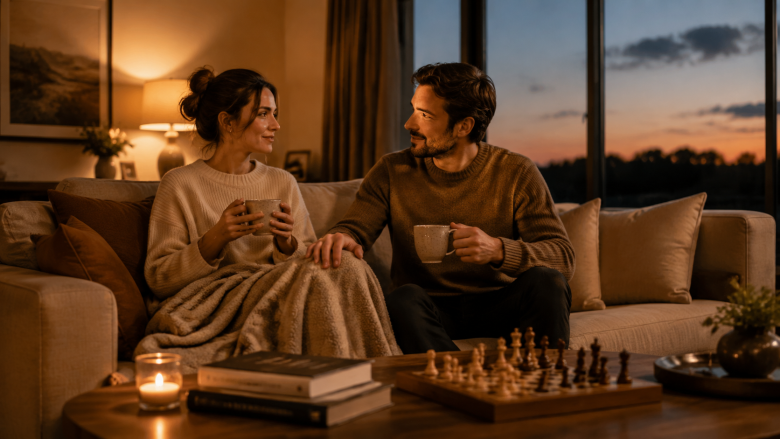
I learned this the hard way. One winter evening, I'd planned a elaborate spa night for us: homemade sugar scrubs, essential oils, a bath with rose petals. My partner arrived home from a 12-hour shift, took one look at the setup, and said, 'I love you, but I just need to sit in the dark and not move.' We ended up drinking tea in silence for 20 minutes, and it was the most connected we'd felt in weeks. That's when I realized: restorative connection doesn't require production.
Here's what that means for your evening routine:
- Calm is contagious. If you can slow your own breathing, your partner's will follow. Silent parallel activities like reading or listening to music together work because they let you regulate side by side without demands.
- Touch without pressure is powerful. Weighted cuddling, where you lie together with a heavy blanket or just hold hands, can lower cortisol faster than any conversation.
- Low-effort is not low-value. The best calming activities for couples often require zero preparation: a shared hot drink, staring at a candle flame, or simply lying on the floor with your feet touching.
For a deeper dive on building simple evening rituals, see our guide on How to Unwind with Simple Evening Rituals. It covers the exact steps to create a repeatable wind-down that doesn't feel like a chore.
Winter-Specific Calming Activities for Couples (When It's Dark and Cold)
Most online lists of calming evening activities for couples overlook the reality of winter. You can't stargaze when it's snowing, and a walk might feel like a punishment. The winter months amplify the need for sensory soothing that doesn't require leaving the house or battling the cold.
The 5-Minute Warm-Up Ritual
Before you even start an activity, spend five minutes warming your bodies together. This can be as simple as making a pot of tea, putting on thick socks, and sitting close to a heater or fireplace. The act of warming up signals safety to your nervous system. I like to use a heated blanket and a shared mug of chamomile or hot chocolate. We don't talk; we just sit and feel the heat return.
Winter Bathing (Not Just Baths)
A bath is classic, but it's often impractical for two people unless you have a giant tub. Instead, try a foot bath with Epsom salts and lavender essential oil. You can sit facing each other, feet in the same basin, and just soak for 10 minutes. It's grounding, requires zero effort, and the warm water helps calm both of you. If you have a larger tub, the research on warm water immersion shows it reduces cortisol significantly within 20 minutes.
Winter Reading Nook Without Screens
One of the best calming evening activities for couples I've found is silent parallel reading in a cozy corner. Find a spot with soft lighting, grab a blanket, and each read your own book for 20-30 minutes. The key is to avoid talking. The presence of another person reading nearby creates a quiet, shared focus. It's a form of co-regulation that doesn't demand anything from you. If you're looking for a structured approach to screen-free evenings, check out our Screen-Free Evening Routine for Better Relaxation.
The 7-7-7 Rule: A Framework for Intentional Weekly Connection
One of the unanswered questions from the search results is how to apply the 7-7-7 rule for couples. It's a simple concept: every 7 days, you spend 7 minutes doing a specific calming activity together, and you do it for 7 weeks. The idea is to build a habit without overwhelming yourself. Most people fail because they try to do too much too fast. The 7-7-7 rule is about consistency, not intensity.
Here's how it works in practice for calming evening activities for couples:
- Choose one activity. Pick something that takes 7 minutes or less. Options: a guided breathing exercise, a 7-minute body scan meditation, sitting in silence with a candle, or a single cup of tea drunk slowly together.
- Do it every 7 days. Pick a consistent day and time, like Sunday evening at 8:30 pm. The repetition is what builds the neural pathway for calm.
- Commit to 7 weeks. After 7 weeks, evaluate. Did it help? If yes, keep it. If not, swap the activity. The framework is flexible, but the commitment is not.
I tried this with my partner using a simple 7-minute breathwork practice: inhale for 4 counts, hold for 4, exhale for 6. The first week, we felt awkward. By week 4, we started looking forward to it. By week 7, it became a non-negotiable part of our week. The thing nobody tells you about the 7-7-7 rule is that the first few weeks will feel like a chore. That's normal. Push through the awkwardness.
Low-Spoon Activities: When You Have Zero Energy Left
There are evenings when even a 7-minute breathwork session feels like too much. These are the nights when you need the lowest-effort calming activities for couples. I call them 'low-spoon' activities, borrowing from the spoon theory of chronic illness. You have only a few spoons of energy left, and you need to use them wisely.
Weighted Cuddling
Lie on your backs or sides, with a heavy blanket over both of you. If you have a weighted blanket, use it. If not, layer two regular blankets. The pressure from the weight activates the parasympathetic nervous system, the same mechanism that makes weighted blankets calming for anxiety. You don't need to talk. You can just lie there for 10-15 minutes with your eyes closed. It's one of the most effective calming evening activities for couples I've ever tried, and it requires exactly zero effort.
Listening to a Single Song Together
Pick one piece of calm music, instrumental preferred. Put on headphones or play it through speakers at low volume. Lie down, hold hands, and listen without speaking. Let the music be the only thing that happens. After the song ends, you can either go to sleep or repeat. This is a perfect no-plan alternative to a movie that ends up being a two-hour commitment.
Shared Tea Ritual (No Talking)
Make a pot of herbal tea, pour two cups, and sit facing each other. The rule: no talking. Just sip, breathe, and be present. The warmth of the cup, the aroma, the gentle steam - all of it soothes the senses. If you need to communicate, use hand gestures or a notepad. The silence is the point. I've found that after five minutes of this, we often feel more connected than after a whole dinner conversation.
Guided Relaxation and Breathwork for Couples
If you're open to a slightly more structured approach, guided relaxation can be a powerful tool for calming evening activities for couples. The key is to choose recordings that are short (10-15 minutes) and designed for couples or partners. Many free apps like Insight Timer or YouTube have guided body scans that you can follow together.
One technique I recommend is the '3-4-5 breath' while lying in bed. Inhale for 3 seconds, hold for 4, exhale for 5. This activates the vagus nerve, which is responsible for the relaxation response. My partner and I do this for 5-10 minutes before sleep. It's simple, but it works. The mistake most people make is trying to do it too fast or with too much pressure to 'get it right.' Just breathe together, even if you lose count.
For a gentle yoga sequence that pairs well with breathwork, see our Gentle Yoga Routine for Evening Relaxation. It's designed for two people but can be done solo if your partner isn't up for movement.
Seasonal Adjustments: From Winter to Spring and Beyond
While this article focuses on winter due to the content gap, the principles apply year-round with small tweaks. In spring and summer, you can take some of these activities outside. For example, the silent reading ritual works beautifully on a porch or balcony. The weighted cuddling can be done with a lighter blanket. The tea ritual can become a cold herbal infusion that you sip while watching the sunset.
The key is to keep the same structure: low effort, sensory focus, and no expectation of conversation. The activities themselves are less important than the intention to be present together without demands.
The Most Common Mistakes Couples Make (And How to Avoid Them)
I've made every mistake in the book when it comes to calming evening activities for couples. Here are the ones I see most often, and how to avoid them.
Mistake #1: Trying to Force a 'Date Night'
Many couples think that any evening activity must be a 'date' with romantic expectations. That's a recipe for disappointment. You're not trying to reconnect; you're trying to regulate. The goal is not to have a great conversation, but to feel safe and calm together. If you put pressure on yourself to have a 'good time,' you'll end up frustrated.
Mistake #2: Choosing an Activity That's Too Long
Even a 30-minute meditation can feel like a marathon when you're exhausted. Start with 5 minutes. If you want to do more, you can always extend. But if you set a time that feels too long, you'll abandon it. The 7-7-7 rule works because it's short. The same applies to any activity: keep it brief and build from there.
Mistake #3: Talking Too Much
Silence is the most underrated tool for calming evening activities for couples. In our culture, we're conditioned to fill silence with words. But when you're both tired, talking can be draining. It forces your brain to process language, think about responses, and manage emotions. Silent activities allow your nervous systems to sync without cognitive load. It's okay to be quiet. In fact, it's better.
Mistake #4: Ignoring the Environment
Your space matters. Dim lights, comfortable temperature, clean surfaces, and minimal distractions all contribute to a calming atmosphere. You don't need to redecorate, but small adjustments - turning off overhead lights, using lamps, putting away phones - make a huge difference. I keep a set of battery-operated candles in our living room. They take 10 seconds to turn on and instantly shift the mood.
A Step-by-Step Evening Wind-Down Plan for Couples
Here's a concrete plan you can follow tonight. It's designed to be flexible, so adjust the timing based on your energy level.
- Transition time (5 minutes): When you walk in the door, set a timer for 5 minutes. Do nothing but change into comfortable clothes, use the bathroom, and take a few deep breaths. No phones, no talking about the day yet.
- Shared sensory ritual (10 minutes): Choose one: tea, weighted blanket, warm foot bath, or a single calming song. Do it together in silence.
- Optional check-in (5 minutes): If you have energy, do a very brief check-in: 'How are you feeling on a scale of 1-10?' No stories, just a number. If you don't have energy, skip this step.
- Parallel activity (20 minutes): Read, listen to music, or do a separate quiet hobby in the same room. No phones, no screens.
- Closing ritual (2 minutes): Before sleep, say one thing you appreciated about this evening. It can be as simple as 'I liked the quiet.'
This plan is a starting point. You can shorten it, shuffle it, or drop steps. The only non-negotiable is the silence during the sensory ritual. That's where the magic happens.
For a more structured evening wind-down that includes sleep preparation, check out our Evening Wind-Down Plan to Ease into Sleep. It's a complementary guide for couples who want to build a complete bedtime routine.
When to Seek Professional Help
Calming evening activities for couples can help with stress and connection, but they are not a substitute for therapy or medical advice. If you or your partner experience chronic anxiety, insomnia, or relationship distress that doesn't improve with these practices, consider speaking with a licensed therapist. The American Psychological Association offers resources for finding a couples therapist. Sometimes, the most calming activity is acknowledging that you need outside support.
Final Thoughts: The Real Measure of a Calming Evening
The best calming evening activities for couples are the ones that you actually do. Not the ones you plan, not the ones you research, but the ones that become part of your routine because they feel good. You don't need a Pinterest-board perfect spa night. You need five minutes of weight on your chest, a warm cup in your hands, and the quiet presence of someone you trust.
Start tonight. Pick one thing from this article - maybe the 7-7-7 rule, maybe the silent tea ritual - and try it. See how it feels. Adjust. Repeat. The goal is not to achieve a perfect evening, but to build a habit of returning to stillness together.