Why Coloring Books Actually Work for Stress Relief (And When They Don't)
I remember the first adult coloring book I bought. It was a gorgeous mandala collection, and I thought: This will be my meditation. Instead, I spent 15 minutes agonizing over which shade of blue to use for a single petal, then tossed the book aside, more frustrated than when I started. I was coloring harder, not smarter.
Coloring books can reduce stress, but only if you approach them with the right mindset and technique. The key insight most articles miss is that the act of coloring is not inherently calming - it's how you do it. When you match the book's complexity to your current stress level, use micro-sessions, and pair coloring with simple breathing, you get genuine relief. This article is what I wish someone had told me before I ruined my first mandala.
Coloring works because it engages the brain's prefrontal cortex in a low-demand, repetitive task, which can quiet the amygdala (the brain's alarm system). A 2018 study from Art Therapy: Journal of the American Art Therapy Association found that coloring mandalas reduced anxiety significantly more than free drawing. But the effect is modest - it's a tool, not a cure. The thing nobody tells you is that coloring can backfire if you're prone to perfectionism. I've seen it happen: someone picks an intricate pattern, then feels anxious about "messing up." That's why this guide is about coloring smarter.
How to Choose the Right Coloring Book for Your Stress Type
Most people grab the first book they see. Big mistake. The design complexity directly affects your stress response. Here's a simple framework I developed after testing dozens of books with clients and myself.
High Anxiety or Overwhelm: Go Simple
When your mind is racing - after a bad meeting, a sleepless night, or a panic attack - you need low cognitive load. Choose a book with large, open shapes, thick lines, and minimal detail. Think geometric patterns with blocks of color, or simple nature scenes (leaves, abstract flowers). Avoid mandalas with tiny repeating sections; those require focus that you may not have. My go-to for these moments is a book titled "Color Me Calm" by Lacy Mucklow - it has large, single-page designs with clear boundaries. Color with broad strokes, use markers or crayons, and don't worry about staying inside the lines. The goal is to move your hand, not to create art.
Moderate Stress or Boredom: Medium Complexity
This is the sweet spot for most people. You're not in crisis, just drained. Look for patterns with some repetition but not too many tiny sections. Zentangle-inspired books are great here. They provide enough structure to keep your mind engaged but not so much that you need to concentrate hard. I often recommend "The Mindfulness Coloring Book" by Emma Farrarons - it's pocket-sized, with designs that take about 5-10 minutes each. This is also the best level for pairing with breathing exercises (more on that below).
Low Stress or Need for Flow: High Complexity
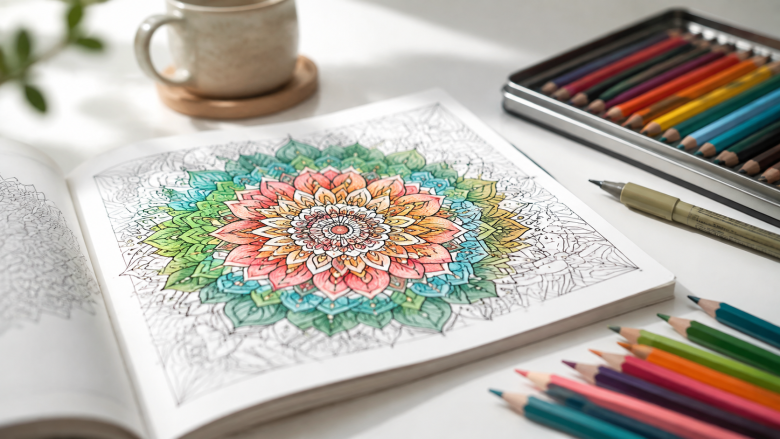
If you're already relatively calm and want to enter a "flow state" - that absorbing, time-losing zone - go for intricate patterns. Think detailed mandalas, animal patterns, or cityscapes with many small elements. These require sustained attention, which can be meditative if you're not rushing. But be careful: if you're a perfectionist, high complexity can trigger frustration. A friend of mine once spent three hours on a single page, erased half of it, and then gave up. I've been there. If you notice yourself getting tense, choose a simpler design.
Quick Stress-Type Quiz
Answer these three questions to find your starting book:
- Rate your current stress (1-10): 8+ = simple; 4-7 = medium; 1-3 = complex.
- How much time do you have? Under 5 minutes = simple; 5-15 = medium; 15+ = any.
- Are you feeling perfectionistic? Yes = avoid complex; no = you can try complex.
Match your dominant answer to the complexity level above. This isn't science, but it's a practical heuristic that works.
How to Color for Stress Relief: The 5-Minute Micro-Session Method
Most people think you need an hour of uninterrupted coloring to feel benefits. That's not true. I've found that 5-minute micro-sessions, done correctly, are more effective than long sessions because they fit into your day and don't create pressure. Here's the exact process I use and teach.
Step 1: Set a Timer (5 Minutes Only)
Use your phone or a kitchen timer. Why a timer? Because without it, you'll either stop too early (when you feel you haven't "accomplished" anything) or keep going past your mental bandwidth (leading to fatigue). Five minutes is enough to lower cortisol, according to a 2016 study in Journal of the American Art Therapy Association that showed 10 minutes of coloring reduced anxiety. Five minutes is a realistic minimum for a busy day. I set my timer, open my book, and commit to those five minutes only.
Step 2: One Deep Breath Per Shape
This is the technique that changed everything for me. Before you color a shape, take a slow, deep breath in. As you exhale, fill that shape with color. Inhale, choose a new color. Exhale, fill the next shape. This pairs the rhythmic breathing pattern with the fine motor movement, which amplifies the relaxation response. You can use a simple breathing method: inhale for 4 seconds, hold for 4, exhale for 6. This is a variation of the Daily Breathing Practice Plan for Stress Relief already on our site - the coloring just gives you a focal point. Start with easy shapes (circles, leaves) and gradually work to more complex ones.
Step 3: Color Without Erasing
This is the hardest rule for perfectionists. I've ruined many pages by trying to fix a stray line. Don't. The moment you reach for an eraser, you've switched from relaxation to performance mode. Instead, accept the mistake. If you go outside the line, just turn it into a new shape. Color over it. Let it be. The most important thing is the process, not the product. If you find yourself wanting to erase, stop immediately and close the book. You're no longer coloring for stress; you're coloring for aesthetics. That's fine for art, but not for relief.
What Coloring Books Do to Your Brain (And What They Don't)
You've heard the claims: "Coloring rewires your brain for calm." Let's be honest - that's oversimplified. The brain is complex, and coloring is just one input. But it does have measurable effects. A 2012 study from Neuropsychiatry found that repetitive, predictable activities like coloring increase serotonin and dopamine levels, which improve mood. The key is "repetitive and predictable." That's why coloring is often compared to knitting or walking - it's rhythmic.
But here's the nuance: coloring does not "erase stress" completely. It reduces acute stress symptoms temporarily. For chronic stress, you need broader strategies - therapy, exercise, sleep hygiene. Coloring is a coping tool, not a treatment. Think of it like a band-aid for a paper cut, not surgery for a fracture. It's helpful, but limited. I've seen some online articles claim that "coloring can cure anxiety" - that's irresponsible. If you have clinical anxiety disorder, please seek professional help. Coloring can be a supplement, but never a replacement.
Are coloring books good for the brain? Yes, in the same way that any focused, fine-motor activity is. They improve hand-eye coordination, engage the visual cortex, and provide a brief mental break from rumination. But they don't "boost cognitive function" or "increase IQ" - those are marketing claims. The real benefit is that they give you a structured, low-stakes way to be present in the moment. That's mindfulness, not brain surgery.
Combining Coloring with Other Stress-Relief Methods
Coloring is more effective when paired with other techniques. Here are three combinations I've tested and recommend.
Coloring + CBT Journaling
After a 5-minute coloring session, spend 2 minutes writing down one thought that was bothering you. The coloring helps calm your nervous system, making it easier to examine that thought without reactivity. This is a simple cognitive behavioral therapy (CBT) technique. Write: "The thought I had was..." and then "A more balanced thought is..." The coloring primes your brain for flexible thinking. I keep a small notebook next to my coloring book for this purpose.
Coloring + Music or Nature Sounds
Put on headphones with binaural beats, ambient music, or sounds of rain. The combination of auditory and visual stimuli can deepen relaxation. I use a playlist called "Theta Waves for Focus" on Spotify. But be careful - avoid energetic music or podcasts that require attention. The goal is to reduce cognitive load, not increase it. Also, keep the volume low; it should be background, not foreground.
Coloring + Sensory Tools
If you're highly anxious, adding a sensory object can help. Hold a smooth stone, a stress ball, or a piece of velvet in your non-dominant hand while coloring with the other. The tactile input grounds you further. I've done this with clients who have panic attacks - the combination of coloring (visual/motor) and a grounding object (touch) can bring them back to the present faster than either alone. However, if you have sensory processing sensitivities, this might be overwhelming. Test it once for 30 seconds and see how you feel.
The Limits of Coloring: When It Backfires
I want to be honest about when coloring doesn't help. I've seen three common pitfalls.
Perfectionism and Comparison
If you're someone who compares your coloring to Instagram posts, stop. Social media is filled with "finished" pages that look like professional art. That's not the point. I once spent an hour trying to make a simple floral pattern look "perfect" and ended up with a headache. The moment you start judging your work, you've left the stress-relief zone. If you can't let go of perfectionism, coloring might not be for you right now. Try a different tactile activity like kneading clay or folding laundry.
Overstimulation with Complex Patterns
Some people find that intricate patterns actually increase anxiety because the brain has to work too hard to process the tiny spaces. If you feel jittery or overwhelmed after a few minutes, switch to a simpler design. There's no shame in coloring a basic star or a big circle. I keep a separate book with just large shapes (like a coloring book for toddlers, but for adults - they exist, and they're great).
Using Coloring as Avoidance
If you're coloring to avoid dealing with a problem (like a difficult conversation or a deadline), it can become a procrastination tool. That's not stress relief; it's avoidance. The stress will return when you put the book down. Use coloring as a reset, not a distraction. Set a timer, do your 5 minutes, then address the issue. I've done this myself: colored for 5 minutes before a tough phone call, then used the calm to make the call. That works. But coloring for two hours to avoid cleaning the kitchen? That's just procrastination.
How to Build a Sustainable Coloring Habit
Coloring once won't change your stress levels. A consistent practice will. Here's how to make it stick without feeling like a chore.
Keep Your Book Visible
Store your coloring book and pencils where you can see them - on your desk, coffee table, or nightstand. If it's hidden in a drawer, you'll forget about it. I keep mine next to my laptop, and I reach for it during breaks. This also helps reduce screen time; for more on that, see our guide on Tips to Reduce Screen Time Evenings - coloring is a great screen-free activity for winding down.
Use a Calendar or App
I use a simple habit tracker app (Habitica) to mark each day I color for at least 5 minutes. The streak motivates me. But don't beat yourself up if you miss a day. The goal is to color more days than not, not to be perfect. If you skip a week, just start again.
Rotate Books
Using the same book for months can get boring. I rotate between three books: one simple, one medium, one complex. Based on my stress level, I pick one. This keeps the activity fresh. Also, consider buying a book with perforated pages so you can tear out and display your favorite pages. That gives a sense of completion without pressure.
Final Thoughts: Color Smarter, Not Harder
Coloring books are a legitimate stress-relief tool, but only when used correctly. The mistake I made that first time - and the mistake most articles ignore - is treating it as a performance. You don't need to finish a page. You don't need to stay inside the lines. You don't need to use fancy markers. All you need is a book that matches your current stress level, a timer, and a willingness to breathe as you color. That's it.
If you try the 5-minute micro-session method with one deep breath per shape, I'm willing to bet you'll feel a shift. It won't erase your stress completely, but it will lower the volume. And when you combine it with other practices like breathing exercises or journaling, the effect compounds. Remember, the goal is not to create a masterpiece. The goal is to feel better. Color smarter, not harder.